

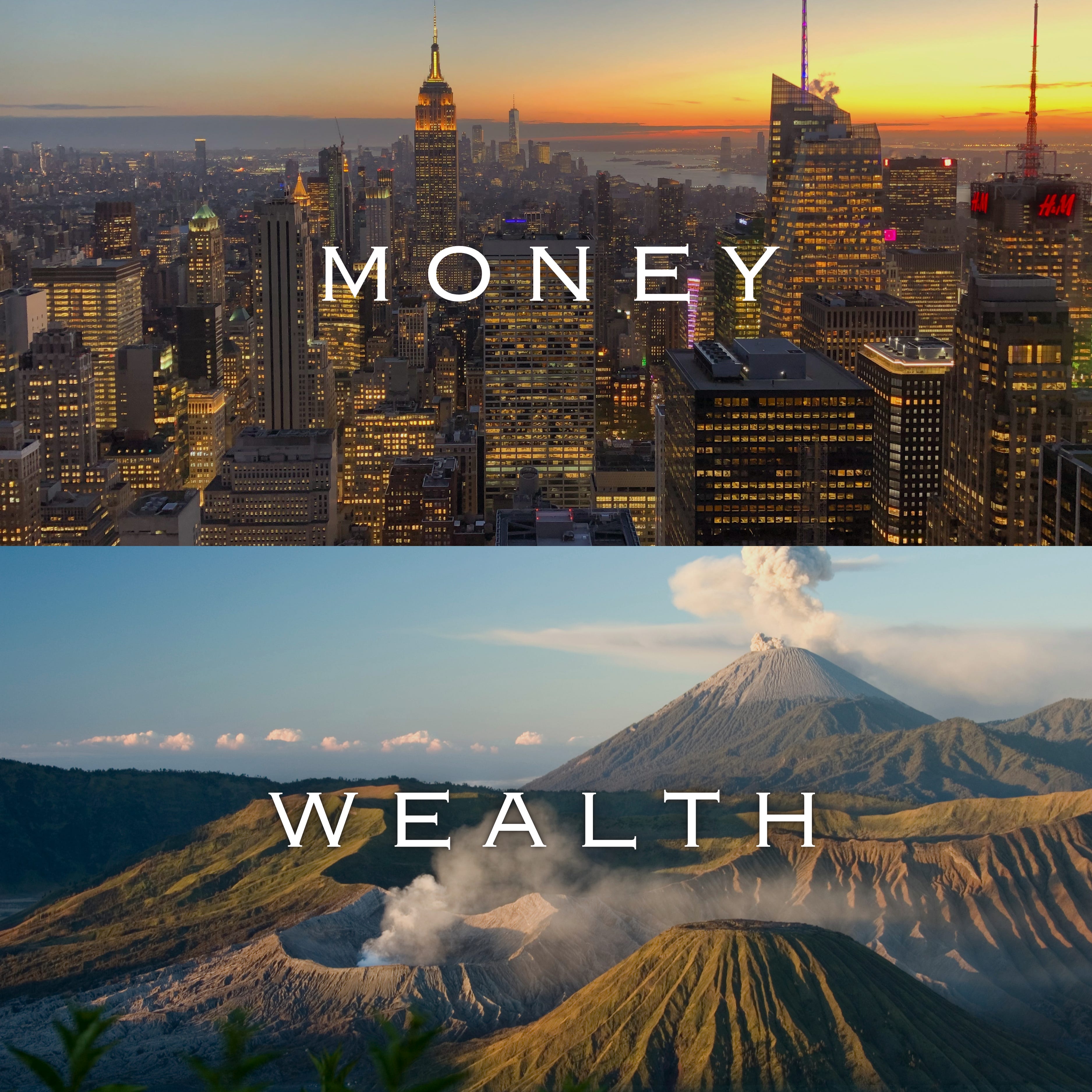
Natural Capital Trader. Classification, 22 August 2026.
Goldman are the best in the business, and I do not say that as a courtesy, I say that because I can, first hand, which is why I want to be careful about what I am claiming here.
Goldmans wrote this report about AI and Nature and what follows is simply how it reads from where I am standing. I have unique abilities (a blessing and a curse) which have served me well. One of them is seeing the unseen. One of them is SEEING what is. It all happened in the first paragrpah:
Nature underpins over $13 trillion in economic value, representing 12% of global GDP,¹ yet the nature-related data needed to price risk, direct capital, and scale sustainable finance does not exist at the cost, quality, or speed markets demand. With finance flows to nature-based solutions at roughly $220 billion in 2023,² a fraction of the $1.9 trillion directed toward climate,³ the gap between ambition and action remains vast, and a key challenge is measurement.
The Report - AI for Biodiversity Measurement: Advancing Nature Finance
This may be the most revelatory document I have read in years, and I do not believe that is what it was written to be.
Lets unpack the first para:
Nature underpins over $13 trillion in economic value, representing 12% of global GDP,¹ They almost lost me in the first sentence using the 2023 PWC report and their famous line that
55% of the world's GDP is moderately or highly dependent on nature.
That moment, which I have had so many times reading this stat, thinking to myself well what is the rest dependant on? made me realise something. The industry, for 3 years now, has taken this stat and used it as their central foundational pillar. The real answer is 100%, they claim
the nature-related data needed to price risk, direct capital, and scale sustainable finance does not exist at the cost, quality, or speed markets demand.
the gap between ambition and action remains vast, and a key challenge is measurement.
“Beyond dedicated nature-specific financial products, nature underpins the core operations of many businesses across the real economy including agriculture, forestry, fisheries and aquaculture, food and beverage, and construction. Together, these five industries generated more than $13 trillion in economic value, 12% of global GDP,⁶ highlighting that nature considerations are relevant to mainstream corporate and investment decision-making”
From these excerpts you get the sense that GS are not all in on this report. Doesn’t feel like it was written by someone who obsessed over writing about nature (that would be odd) and then we find out the report did take 3 years to write. In a word, i was feeling apathy was present in the hand of the holder of the pen.
Why am I point out these slight tells, these details? Well because when there is apathy and malaise involved you get situations where there can be a knockout, an oversight, a cat might have got out of the bag unknowlingly. And thats what happened.
In this report, Goldmans are saying that getting here today to this number it has been
Twenty years of frameworks, taxonomies, disclosure standards, pilots, working groups and conference halls.
Millions of air miles flown to argue about nature and the balance sheet, the commons, the value of the unpriced.
Two decades of a hot air daisy chain, each link fastened to the last, none of it fastened to the ground.
And in these pages, knowingly or otherwise, Goldman Sachs names the foundations. Not by advocating for them. By listing, in the course of explaining why nature finance has not scaled, the precise properties whose absence is the reason, without appearing to notice that the list is the answer rather than the excuse.
The report says the problem is measurement.
Really? Lets see about that…