

NATURAL CAPITAL TRADER | DISPATCH: INSURANCE | 13 AUGUST 2026
Insurance is the oldest continuous commercial instrument on earth. It is older than the joint stock company, older than the central bank, older than most of the states whose flags now fly over the exchanges where it is written, and every container that leaves a port this morning moves because somebody, somewhere, agreed to put a price on a thing that has not happened yet.
That instinct is the entire inheritance. Everything built on top of it is administration.
So hold two numbers next to each other and let them sit there.
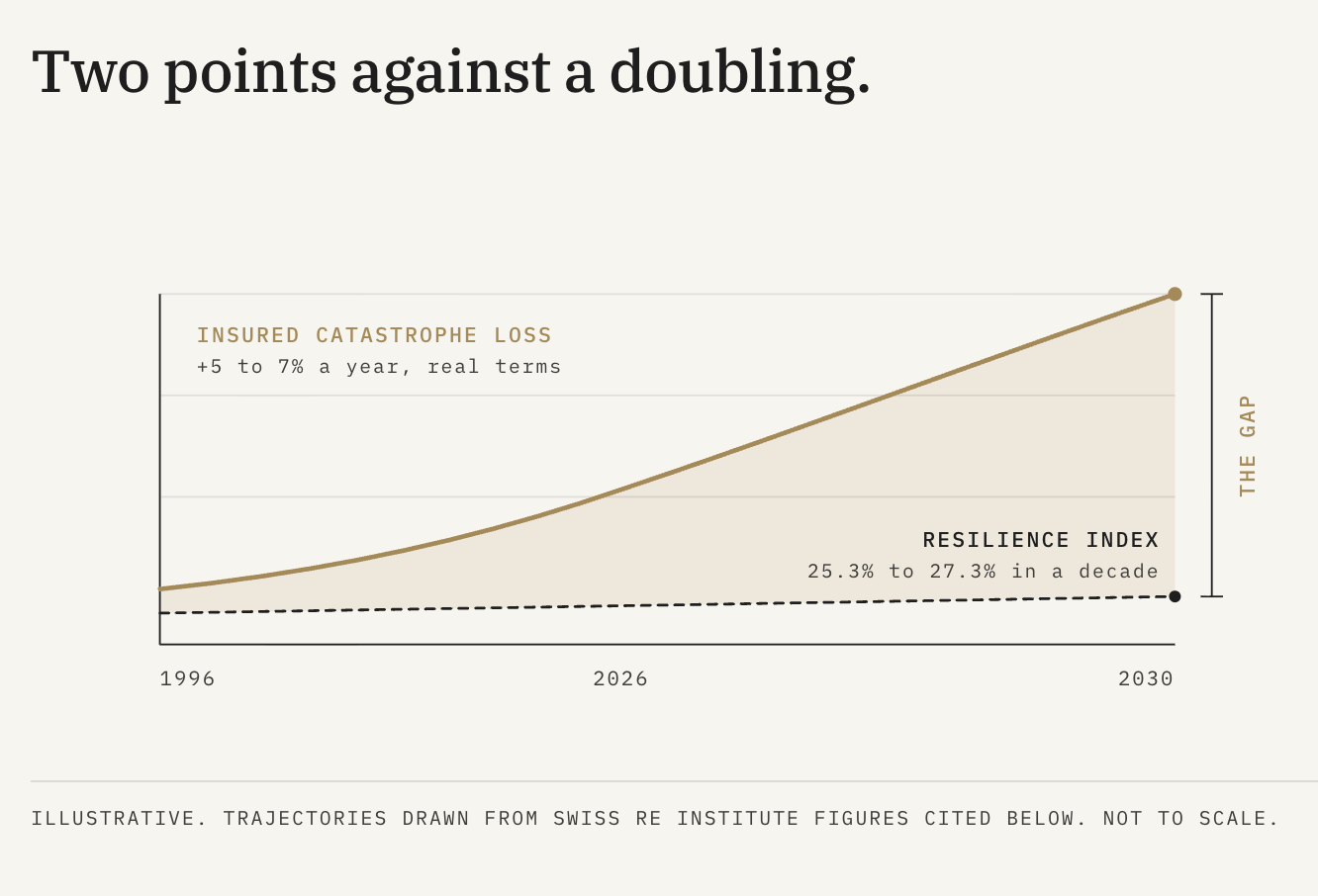
Over the past decade the industry’s own resilience measure moved from 25.3 per cent to 27.3 per cent. Two points, earned across ten years of modelling investment, capital discipline, product design and regulatory attention, in the largest and best capitalised risk market that has ever existed.
Over the decade ahead, insured natural catastrophe losses are compounding at five to seven per cent a year in real terms, which is the rate they have held for thirty years, and which delivers a doubling.
Two points against a doubling.
THE ARITHMETIC, SO THAT NOBODY HAS TO TAKE IT ON TRUST
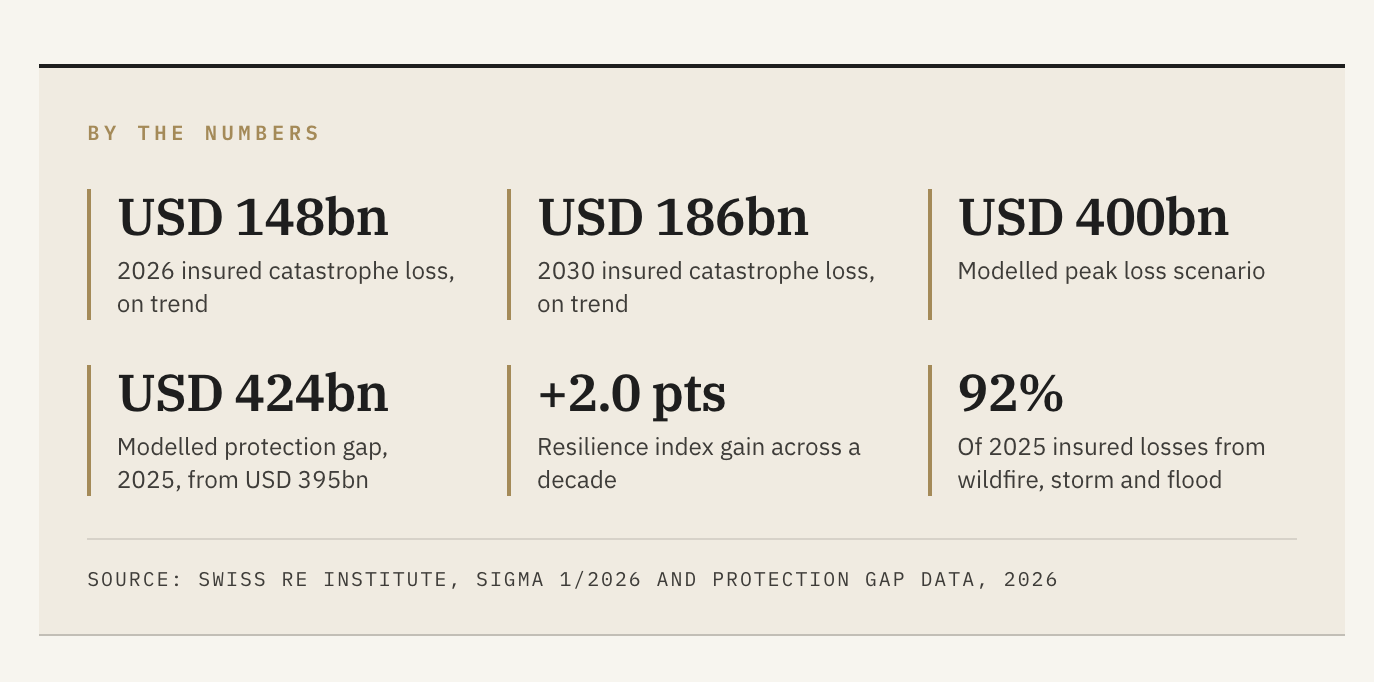
Swiss Re Institute puts 2026 on trend at USD 148 billion and 2030 at USD 186 billion. A peak loss year could exceed USD 300 billion, and the modelled peak scenario reaches USD 400 billion.
A cycle is a thing that returns to where it started. These figures do not return. They are not describing a cycle, and treating them as one is the single most expensive assumption on the book, because a cycle can be ridden out with capital and a direction cannot.
THE YEAR THAT READ LIKE A REPRIEVE
2025 came in at USD 107 billion against the USD 140 billion the trend implied, and across the market the year was received as evidence that the curve had begun to bend.
Swiss Re, to its considerable credit, described it as what it was: a favourable draw rather than a reduction in risk. That is a sentence written by people who know precisely what they are looking at, and it deserves to be read as carefully as it was written.
Look at the internals. The second half of 2025 produced 17 per cent of the year’s insured losses against a normal share of 60 per cent. The third quarter came in at 9 per cent, the lowest in thirty years of records. No major hurricane made landfall in the United States.
Now look at the sky over that same season. The North Atlantic produced three Category 5 hurricanes, the second highest count ever recorded, and 60 per cent of the season’s hurricanes reached Category 5, which is the highest share in the entire record.
The hazard set a record in the same season the losses came in a third below trend. The only variable standing between those two facts was where the storms happened to go.
There is a second figure from that year worth handling with the same care. 2025 set a record insured share, at roughly half of all catastrophe losses. It did. It set that record because the year’s losses concentrated in Californian wildfire and American convective storm, which are the best covered perils in the best covered market on earth. The insured share rose because of where the fire was, not because more of the world got covered.
A quiet year is not a safer world. It is a steering outcome in the North Atlantic. Nothing in the ground improved, and the ground is where the loss is decided.
THE PERILS HAVE COME DOWN OUT OF THE SKY
In 2025, wildfire, storm and flood produced 92 per cent of global insured losses. Wildfire is the fastest growing peril on the book, at around 12 per cent a year. Across the fifty-five years to 2025, convective storm, wildfire and flood account for roughly two thirds of the growth in insured catastrophe losses.
Read that list again with an eye on where each one is actually decided.
Fire resolves on the state of the fuel, which is to say on what is standing, how dry it is, and how continuous it is across the ground.
Flood resolves on the capacity of the surface to take water in rather than shed it.
Wind loss resolves, far more often than the adjuster’s file ever records, on what the root and the soil were holding before the gust arrived.
THE SKY
For the past 30 years the insurance industry has been looking into the sky to get a read on the situation. The results speak for themselves.
The problems we have today are because the losses are being determined by the ground.
Once this became clear everything changed for me. I thought we had an existential problem!
So……..I am not full of despair, in fact, I am far far from it. Why? Because I understand the land, the soil, the dirt, the leaves, the trees, the SUBSTRATE.
THE LEG THAT WAS ASSUMED
Every catastrophe model in commercial use derives terrestrial loss from atmospheric inputs alone. Rainfall. Wind speed. Ground shaking.
Three legs, and a table that has been wobbling for a decade while everybody at it agrees the floor must be uneven.
The fourth leg was never removed by decision. It was never installed, because the ground entered the equation as a constant, and thirty years ago that was close enough to true to hold the weight. Then several hundred million hectares changed state in the name of development, and the assumption quietly stopped being true while the equation carried on as though it had not.
Consider what that does to a single number. A hundred millimetres of rain falling on intact substrate used to produce no claim at all. The same hundred millimetres arriving on an exhausted catchment now produces a catastrophic flood loss. Same sky, same millimetres, same polygon on the same map, and a model that cannot tell the two apart because the field that would distinguish them does not exist in the file.
The industry has a name for the difference. It calls it basis risk, and it treats it as a permanent actuarial tax, something to be managed through backtesting and mitigated at the margins but never removed. Swiss Re’s own guide states that it can be reduced and never fully eliminated. The FSI and the IAIS say the same thing in their own language.
That is an accurate description of the problem as currently posed. It is not a description of the problem.
Basis risk is not a tolerance, and it is not a data granularity problem, which is why no additional volume of satellite imagery has closed it and no further resolution ever will.
Basis Risk is the observable signature of a missing variable.
The index and the loss decouple because the thing that mediates between them is absent from the equation, and a variable that is absent cannot be recovered by measuring the present ones more finely.
You cannot resolve your way to something that is not in the frame.
Draw me a picture
This is the best way to learn anything, and the simpler the better.
This is how simple it is to fix the parametric insurance problem.
THE POLYGON IS A PHOTOGRAPH
A polygon is a boundary in space. The exposure is a position in time.
The industry has mapped, to an astonishing degree of accuracy, where every asset sits. It has not classified when that asset sits, because biological time runs on its own clock, indifferent to the renewal date, indifferent to the reporting period, and entirely indifferent to the fact that the polygon was drawn seven years ago by somebody competent using the best data then available.
A polygon drawn in 2019 describes ground that no longer exists in 2026. The file will not tell you this, and the file is not at fault, because there is no field in it in which such a thing could be said.
It is underwriting from a photograph of something that has since moved.
WHAT WAS FOUND INSIDE A WRITTEN-OFF POLYGON
This part is on record.
I hold a classification on a large southern hemisphere catchment. Class IV. Post-threshold.
In May 2026 that catchment took an extreme rainfall event. The principal dam rose from 32 per cent to 113 per cent of capacity in twenty-four hours and overflowed at 2.2 million litres per second.
The dam did exactly what it was built to do and did not fail structurally. What it could not hold was a catchment that had failed hydrologically long before the rain arrived.
The weather models registered that rainfall to the millimetre, which is the thing they were built to do and which they do superbly. Nothing anywhere in the stack was built to register that the ground beneath the rain could no longer take it in.
Here is the part that matters commercially.
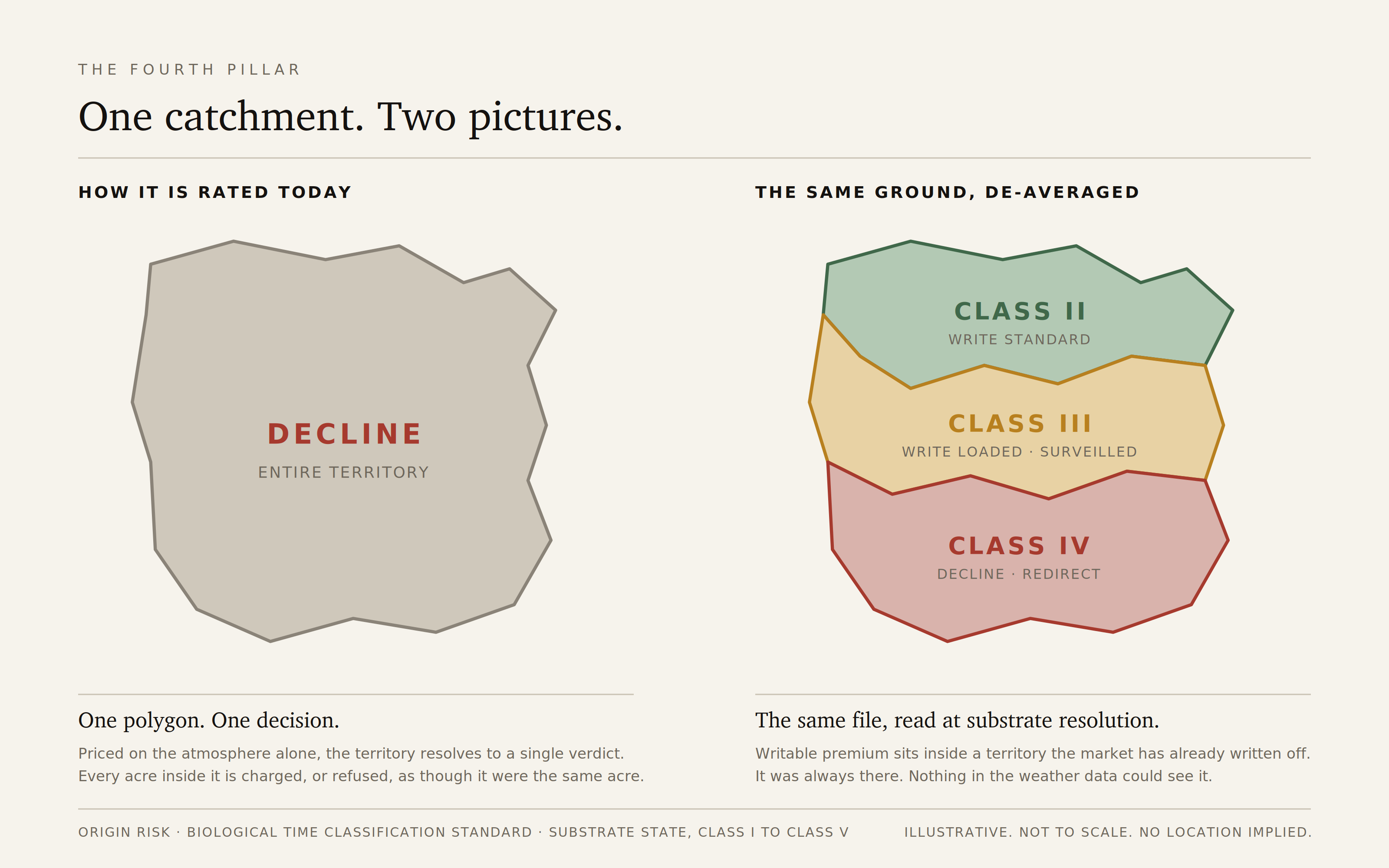
Inside that written-off territory, one sub-catchment was holding. It was restoring receptive capacity while the ground on every side of it shed water at velocity. Same weather. Same file. Same boundary drawn on the same map.
Different ground.
ONE TERRITORY, THREE PRICES
Consider what that means for whoever is carrying the book.
The underwriter who declined the territory declined premium that was writable at standard rates. The underwriter who wrote it uniformly charged resilient ground to subsidise exhausted ground and called the blend prudence.
Both made the same error, which was to treat the polygon as the unit of decision.
De-average it and the territory resolves into three positions, each carrying a different action. Write standard. Write loaded, with surveillance. Decline standard cover and redirect to a state improvement policy. One territory, three prices, and not a single additional square metre of exposure taken on anywhere.
None of that is visible in the weather data. All of it was there the whole time.
THE LOOP THAT FUNDS ITSELF
Here is the second order effect, and it is the one that reaches beyond the loss ratio.
Substrate state is directional. It moves both ways.
An estate that moves its ground from one class to a better one has changed its own price, not through a negotiation, not through a disclosure, and not through a pledge, but through a registered physical change in the receptive capacity of its land.
Run the arithmetic on that and the restoration outlay pays back inside three years on premium saving alone. Not carbon revenue. Not grant funding. Not concessional finance. Premium.
That is a self-funding resilience loop, and the fuel in it is the ordinary commercial self-interest of a farmer who would quite like a lower renewal.
Now consider what that does to everything sitting adjacent to it. Carbon markets pay for intent, which is precisely why they are being repriced as we speak. Biodiversity credits pay for methodology. Sustainability finance pays for disclosure. All three, in the end, pay for a document.
An insurance instrument pays on verified physical change. That is not an innovation anybody needs to be sold. It is what this industry already does every ordinary working day, at scale, under supervision, with the arithmetic audited. It is the only institution on earth structurally built to pay for a state rather than a story.
Restoration becomes bankable at the moment it becomes underwritable.
That is not adjacent to the business. It is the business, run in the other direction.
WHAT UNINSURED LAND ACTUALLY DOES
Withdrawal is rational for the individual underwriter and catastrophic for the system, which is the signature of every genuinely difficult problem in finance.
When cover exits a territory, the land does not hold still and wait to be reassessed.
Cover withdrawn is lending withdrawn, because no bank will hold unhedged physical exposure.
Lending withdrawn is capital expenditure deferred.
Capital expenditure deferred is maintenance forgone, so the receptive capacity of the ground falls further, the next event lands on worse ground than the last one did, and the larger loss that results reads in the file as vindication of the original decision to leave.
That is a doom loop. The industry is currently inside it, calling it prudence.
Swiss Re models the natural catastrophe protection gap at USD 424 billion for 2025, against USD 395 billion the year before. That is a modelled, premium equivalent measure, and it is not the same thing as uninsured loss realised in any single year. The realised number moves with wherever the weather happened to land. The modelled number moves with the structure underneath it.
The structural one is the one getting larger.
The protection gap is not a distribution failure. It is a classification failure. Nobody withdraws from land they can see. They withdraw from land they cannot price, and they cannot price it because the variable that decides the loss is not in the model.
WHY NOBODY INSIDE THE ROOM CAN SEE IT
The apparatus that now surrounds the trade is very good at one thing in particular, which is agreeing with itself.
A model validates against a benchmark constructed from the same assumptions. A committee reviews it against a peer set trained in the same streams by the same institutions using the same texts. A signal that does not fit the equation is not rejected on the merits, because it never reaches the merits. It is simply never entered, since there is no field in which to enter it.
The missing pillar is not an oversight by any individual underwriter, and it is not a failure of intelligence or diligence anywhere in the chain. It is what a closed loop does. The ground has been absent from the equation for so long that its absence has become invisible from the inside.
Reading a risk the crowd cannot read is not a departure from the trade. It is the trade.
THE MONEY THAT WAS ALWAYS ON THE BOOK
Nothing in this requires writing more limit at longer odds. Nothing here asks for new capital, new capacity, or fresh appetite for a class already declined.
Same book. Same territories. Same triggers. One pillar beneath them.
Some of what you carry today is mispriced against you, and some of it is mispriced in your favour, and at this moment there is no instrument on the desk that distinguishes the two, so the average gets priced and the width gets loaded to survive the tail.
Every basis point of that width is the cost of not knowing.
You are not missing premium. You are missing resolution on premium you already write. The margin does not have to be created. It has to be seen.
And the territories that have been exited are not uninsurable. They are unclassified. Those are two different words, and the distance between them is a market.
THE TWO QUESTIONS A COMMITTEE WILL ASK
Can it be proven retrospectively?
Yes. The substrate effect can be isolated from the meteorological effect retrospectively, against events already sitting in your own claims history. The framework for doing it ships in the brief, written to be run by your own actuarial team, on your own territory, against your own numbers. It is a validation instrument for a risk committee. It is not the classification method, and it never will be.
Who benefits from the classification?
Nobody who issues it. Origin Risk classifies substrate on the BTCS standard and holds no commercial interest in any placement. MAATTR licenses commercial access to the classifications and holds zero influence over the classification outcome. Common ownership by Matthew Ross is disclosed in full, in writing, in every engagement.
A rating that can be bought is not a rating. The firewall is the product.
WHAT THIS LETTER IS NOT
It is not a request for a pilot.
It is not software, a platform, or a data feed.
And it is not the read.
I am not going to show you the read. Not in this letter, not in the brief, not at any price above it.
The framework is disclosed. The calibration is sealed. Moody’s publishes its rating scale and not its model file. Origin Risk publishes the class and not the derivation. That boundary is permanent, and it is not subject to negotiation, commercial pressure, or curiosity.
The argument here is not that basis risk ought to be eliminated. It is that basis risk is avoidable, that the polygon is antiquated, and that the only durable mechanism for restoring land at scale is incentive rather than instruction.
The industry arrives at this eventually. The only open question is whether it arrives before the two lines finish diverging, or after.
FIRST-LEVEL ACCESS
The brief is issued as a numbered First Series of five.
Five copies. Each one serialised, registered to the named institution that holds it, and recorded on issue. Controlled circulation, which is how a classification document ought to travel.
I deeply want this to be taken by the insurance industry because it is extremely important to me. Therefore I have loaded this offer with x10 - x100 the value of the price being asked.
The diagram above, when classified and premiums collected returns x120 the value of the price below. That is just one example.
What a copy carries
The case in full: the written-off catchment, the Class II sub-catchment found inside it, the event, and the ledger of what each position was worth once the polygon was de-averaged.
The four-pillar architecture: where substrate state sits beneath the meteorological trigger, and why granularity cannot close the gap regardless of how much of it is purchased.
The backtest framework: written to be run by your own actuarial team, against your own claims history, on your own territory. A validation instrument for a risk committee, and not the classification method.
Insurable interest and the supervisory position, including the French index-only prohibition.
Restoration Insurance: the state improvement trigger and the product architecture it supports.
A portfolio mapping session: ninety minutes with MAATTR. You bring a territory. We tell you what is classifiable in it and what is not. A commercial conversation, not a methodology conversation.
At checkout you nominate the peril your book carries heaviest: agricultural, flood, wildfire, or aggregate territory. That nomination changes nothing about your copy of the First Series. It determines what the Second Series covers.
What a copy does not carry, at this level or at any level above it, is the method. The framework is disclosed and the calibration is sealed. What deepens as you go up is not disclosure. It is specificity to your own book.
WHAT TO DO WITH IT ON THE DAY IT LANDS
Take one polygon in your own book. Take the one already declined, the territory that went to a blanket exit two renewals ago and has not been opened since.
Then ask whether that polygon is one decision or three.
You will not need us to answer that. Once the question is in front of you it answers itself, and it will keep answering itself every time you open a file. You will need us for what comes after, which is the part that has to be issued rather than reasoned.
That is the whole value of the First Series. It costs less than a single day of the actuarial time it would otherwise take to arrive at the same question unaided, and it arrives with a live case attached rather than a theory.
First Series, copies 1 to 5.
Only USD $4,800 each.
The window closes Friday 28 August 2026. All five copies are issued that day, serialised and registered to the institutions holding them. If fewer than five are taken, the series closes on the same date regardless.
Matt Ross Founder, MAATTR
MAATTR licenses classifications issued by Origin Risk. Both are held by Matt Ross, and the common ownership is disclosed in full. Classification cited: OR-EC-2026-001, Class IV Post-Threshold. Issued by Origin Risk.
Loss and resilience figures: Swiss Re Institute, sigma 1/2026, and Swiss Re Institute natural catastrophe protection gap data, 2026. Territory diagram is illustrative, not to scale, and no location is implied.
Classification states biological position. The board determines action.