
Substitutionary Atonement
The city named for the body of Christ is being sacrificed for the sins of the energy system. The second coming is here, just not the way you thought.

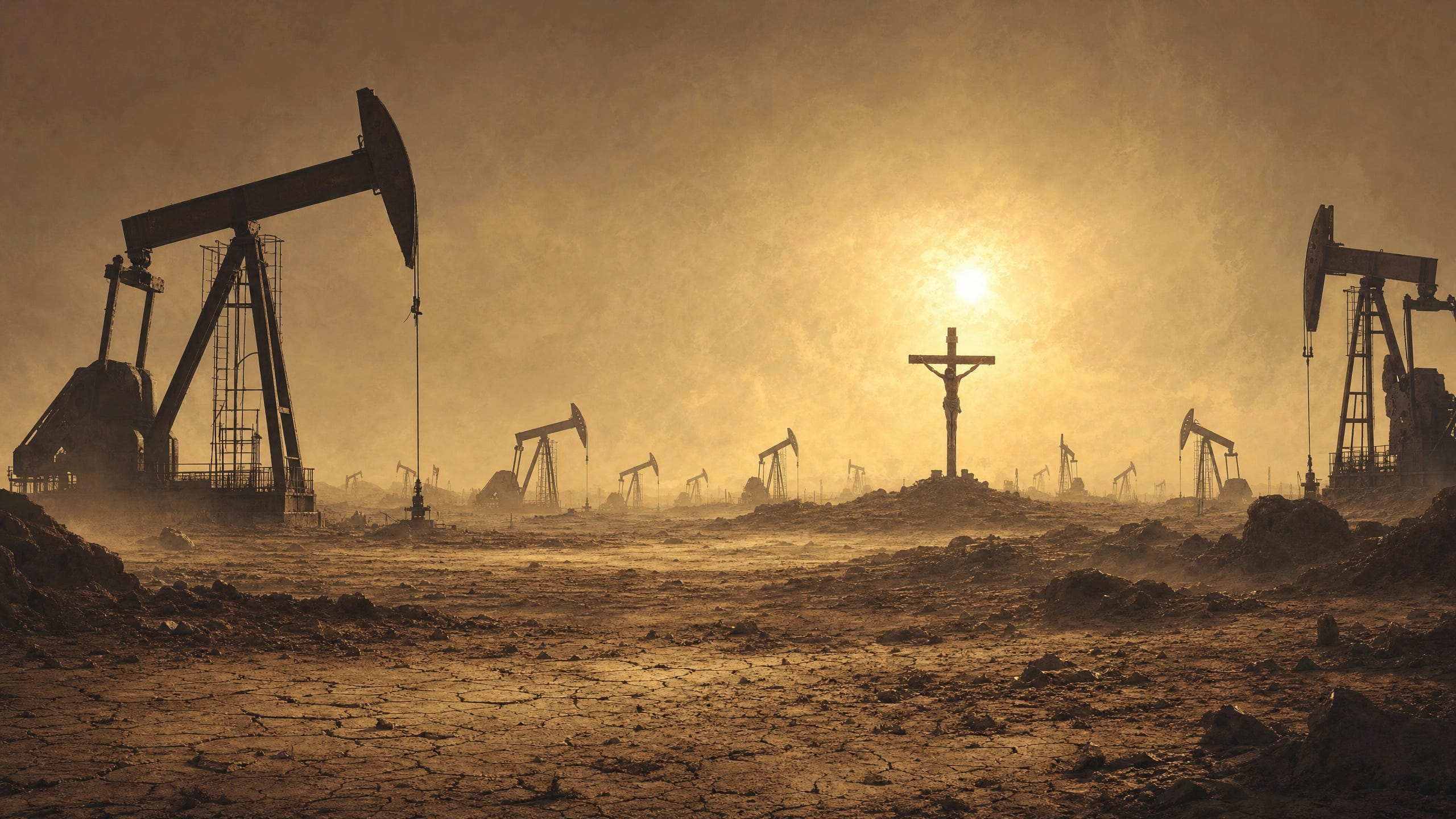
Substitutionary atonement is the theological doctrine that Christ did not die for his own sins but for everyone else’s. Christ gave himself freely, carrying the full accumulated weight of a debt that was never his to bear, so that those who had created the debt could continue on as though it had never existed. History repeats, so what makes the doctrine so enduring is not the sacrifice itself but the structural logic underneath it, which is that someone had to pay, that the liability had to land somewhere, and that the most powerful parties in the arrangement made sure it landed on the one least able to refuse.
It is happening again in Texas, in a city whose very name announces the victim in advance.
Corpus Christi, the body of Christ, sits at the mouth of the Nueces River where it meets the Gulf of Mexico, and for the past decade it has been the beating heart of the American energy export complex, the country’s top port for crude oil, the refinery hub that processes five percent of the nation’s gasoline, jet fuel, and diesel.
Since the main oil artery has been blocked for 3 months, Corpus Christi is the place where the Permian Basin’s output meets all of the new incoming tankers heading to Europe and Asia. The narrative has gone into overdrive with the promise that American energy dominance is real, durable and is only just beginning.
Corporations have invested seven billion dollars in this corridor over the last ten years, among them Flint Hills Resources, Valero Energy, Citgo, ExxonMobil, and Saudi Aramco, and what every one of those investments had in common, beneath the financial models and the engineering assessments and the political backing, was an unspoken assumption that the water would always be there.
The water is not there.
The city’s two main reservoirs, Choke Canyon and Lake Corpus Christi, are sitting at eight percent of combined capacity, and in March of this year the Governor’s own chief of staff, Robert Black, wrote to the Texas Commission on Environmental Quality with a sentence that should have alerted every energy desk in the world: “Disaster is on the doorstep of the City of Corpus Christi.” Of course it did not, they don’t live in this world, they just care about the profit.
That letter also contained a detail that has been obscured and received none of the attention it deserves. The city’s own public water dashboard had been displaying March 2027 as the projected date of critical failure, and Black’s letter moved that date to May 2026, meaning that nearly a year of reckoning was compressed into a single emergency directive, and the tankers kept loading, and the assets kept trading, and the narrative kept warm.
Why Here, Why First, and Why the Corporations Will Not Pay
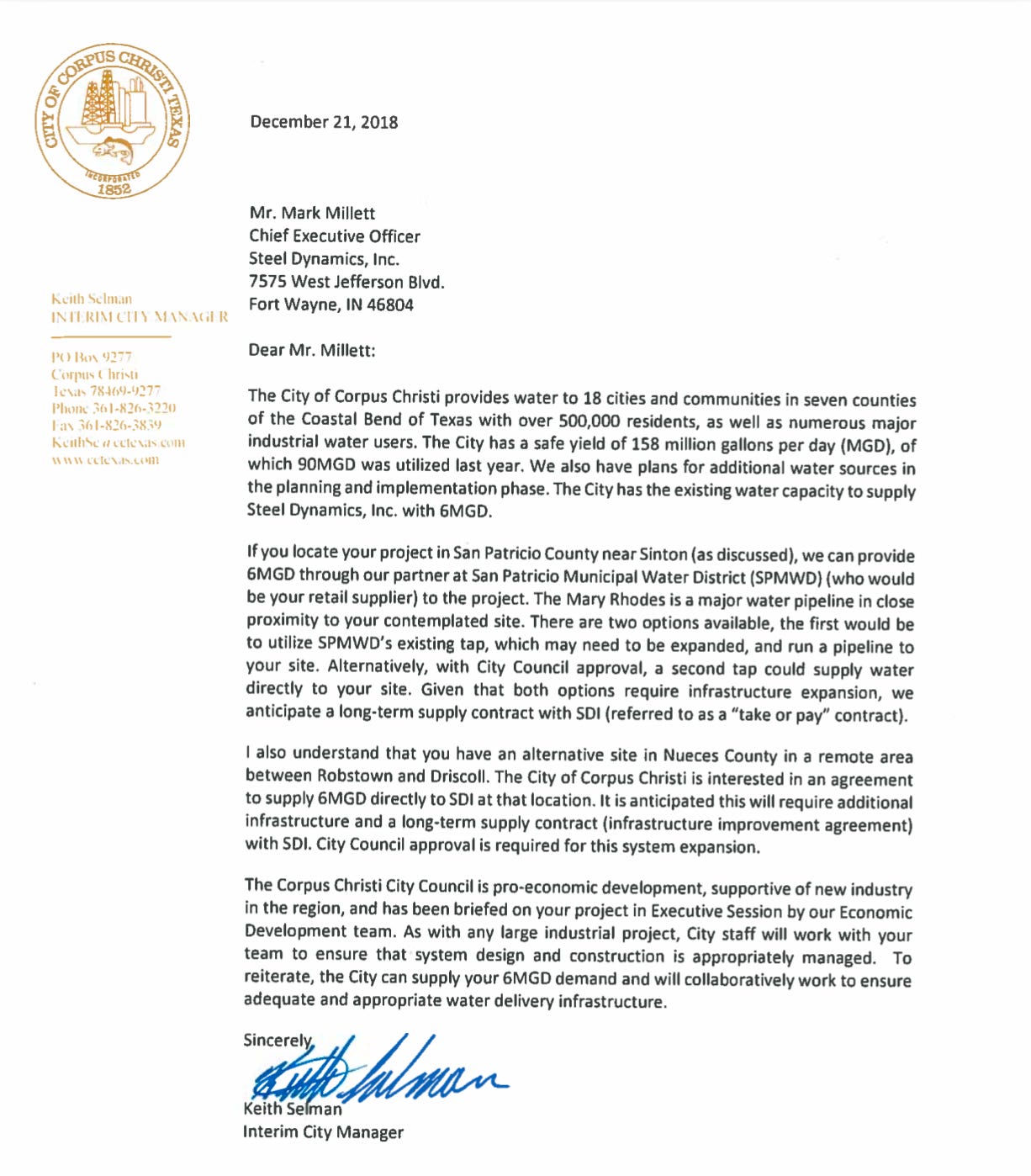
The reason Corpus Christi is the first major energy hub to reach this point is not bad luck and it is not primarily a story about drought, even though the drought is real and severe and has been deepening for years without adequate response. The reason is that the city spent a decade building industrial water demand on top of a supply system that was already stressed, welcoming corporations whose water footprint dwarfed anything the city’s infrastructure had been designed to accommodate, and repeatedly failing to build the alternative supply that everyone involved knew was necessary, because the cost of building it was always easier to defer than to face.
ExxonMobil and Saudi Aramco opened their Gulf Coast Growth Ventures plastics plant in 2022, and that single facility has the designed capacity to consume as much fresh water as every residential user in the city combined. When ExxonSaudi opened the reservoirs were already declining, and the desalination plant that the city had been discussing for twenty years was still not built. Nobody with the power to require the corporations to secure their own water supply chose to use it because the seven billion dollars of industrial investment was the story the city wanted to tell about itself and corporate water liability was not part of that story. Narrative over reality.
What those corporations pay per thousand gallons of municipal water is not publicly disclosed. Why? The significance of that silence is out of character because the city is proposing to pay a new company $6.50 per thousand gallons for desalinated water from a plant that does not yet have a location, built by a company set up two months ago. While the industrial users consuming the majority of the supply pay a rate that the public is not permitted to know, in a city whose reservoirs may be empty before this article finishes circulating.
The company offering the $6.50 rate is called AXE H2O, it was incorporated two months ago in Houston, it has no site selected for the $1.3 billion dollar plant it is proposing to build and it is asking the city to commit to purchasing between 50 and 150 million gallons per day from it for a minimum of thirty years. Strong. This is a commitment that a council member described, in a moment of unusual candour, as sounding wonderful but being sort of like too good to be true, and the council voted six to two to begin talks anyway because the alternative is a city with no water. The desperation in that vote is a more honest measure of the situation than any official statement that has been released.
Governor Abbott’s solution to the funding question is equally instructive. Rather than requiring the corporations who built seven billion dollars of infrastructure on the assumption of cheap municipal water to fund the supply infrastructure their operations depend on, he has directed the Texas Water Development Board to offer the city $700 million dollars in low-interest loans that will be repaid through higher water bills and property taxes levied on the residents of Corpus Christi.
The residents, who consume roughly 40% of the city’s water supply will bear the cost of securing the 60% that keeps the refineries running.
Chris Tomlinson wrote the clearest summary of this arrangement in the Houston Chronicle: Corpus Christi has plenty of water for residents. What the city lacks is enough water for the massive petroleum complex owned by major corporations that refuse to supply their own. coastalbendcurrent
This is not a governance failure in the conventional sense. It is the rational output of a system that has always been structured so that infrastructure costs are socialised and extraction profits are privatised. What is unusual about Corpus Christi is not the structure but the visibility. The fact that the deferred liability has surfaced so completely and so quickly that the mechanism is no longer deniable to anyone paying attention.
What the Decade of Deferred Decisions Actually Built
The city manager, Peter Zanoni, has been in his role since 2019 and when he described the situation earlier this year he reached for language that is either devastating self-awareness or the most understated summary of institutional failure in recent memory.
(*note - I recently went to Texas and spent a great 3 days there with an amazing host and his wonderful wife and mother. Texas and Texans are great people, strong, funny, awesome food. I loved it there. So please know that I believe these people in the water dept are a different breed).
Zanoni was saying that the city simply had not kept up with water supply and water infrastructure and that the problem was decades in the making. He is describing a situation in which the warning signs were not hidden, technical or ambiguous, but visible and documented and consistently overridden by decisions that prioritised industrial growth over hydrological sustainability. This happened year after year, administration after administration, until the reservoir hit eight percent and the Governor’s chief of staff started using the word disaster.
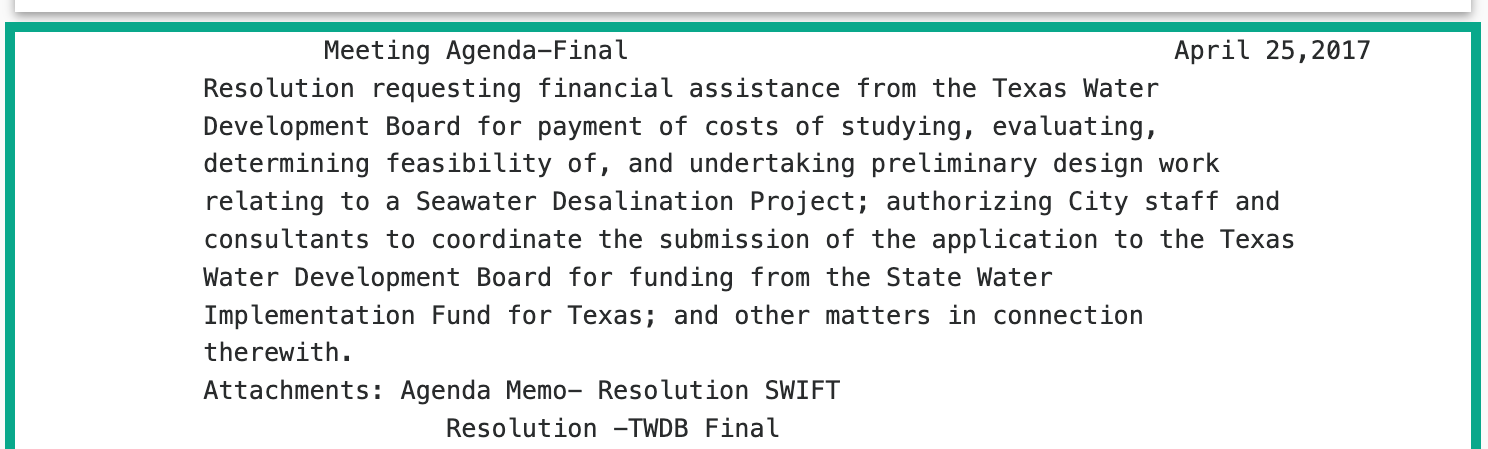
The promised desalination plant is the clearest expression of this pattern. The city has been attempting to build one for more than twenty years. In 2019 the proposed cost was $160 million, by last year it had reached $1.2 billion. The City Council cancelled the contract in September 2025 on grounds of cost and concern about discharging hypersaline brine into the enclosed ecosystem of Corpus Christi Bay. Not sure if he knows the rivers in parts of Texas are now in a state of ‘hyper salinity’, esentially brine water.
Biology is unaware of human incompetence. It carries on. The drought continued, the reservoirs continued falling and the industrial demand continued growing Now the council is simultaneously trying to revive the cancelled Inner Harbor project, evaluate the two-month-old AXE H2O proposal, consider a brackish water project from Seven Seas Water Group, and manage emergency groundwater extraction from the Evangeline Aquifer that is already depleting private wells in the surrounding rural communities. It is doing all of this without permits because Abbott has suspended the regulatory requirements that would normally govern this kind of extraction as the alternative is running out of water this month.
Council Member Mark Scott took his seat in January 2025 and his description of the experience since then was: “We’ve been in panic mode since the day we were sworn in”. There you have it. The truth.
Scott is telling everyone these two things
The crisis has not arrive suddenly
The city has no plan for it when it does
The people in charge of 360,00 residences have no manual, no precedent and no clear protocol for how a Level 1 Water Emergency would actually be implemented across a system where the largest industrial users have the option to pay a surcharge to exempt themselves from the restrictions that will apply to everyone else.
A Level 1 Water Emergency requires a mandatory 25% reduction in all water use. This is roughly 30 million gallons per day.
*note - Quick math - this would mean AXE H2O would receive an average $750,000 per day. The $1.3bn returns in under 5 years.
Now, for some beautiful, clarifying truth - The Mayor said the situation has reduced the city’s leadership to understand there is only one person who can save them. They said it in public, at a council meeting. You know this means only one thing - all the options have genuinely run out: “We pray to God that this comes through.”
The Ground the Revolution Was Built On
The Corpus Christi situation is the most visible current expression of a structural condition that runs through the entire American shale thesis. From the Permian Basin wellheads to the Gulf Coast export terminals. The “shale revolution” was not only extracting oil but was simultaneously destroying the water systems that the downstream infrastructure depends on to operate and both processes were happening in the same geography at the same time. Neither of them appeared on the balance sheets of the assets that capital was being allocated into.
The Permian Basin produces four barrels of chemically contaminated produced water for every barrel of oil it extracts, and in some formation pockets the ratio reaches ten to twelve barrels of produced water per barrel of oil. Texas is producing 400% - 800% more toxic water than oil. This water cannot be returned to the water cycle or reused in most applications, so what do they do? It is injected underground at volumes that have increased by +7,000% over the last fourteen years, with more than 8.57 billion barrels injected in Reeves County alone between 2010 and 2025. The accumulated underground pressure from this injection is seismic and now generating documented concerns about upward migration of contaminated water through old, corroding well casings into the aquifer systems above them. The “revolution” is not merely depleting the water it needs to function but is actively contaminating the reserves that might otherwise buffer the depletion.
The United Nations University’s Institute for Water, Environment and Health published its Global Water Bankruptcy report in January of this year. The language was precise, in a way that scientific institutions rarely allow themselves to be, declaring formally that:
the world has entered a post-crisis condition in which long-term overuse has made the return to historical baselines irreversible in enough critical systems that the risk landscape for everything built on top of those systems has been fundamentally altered.
Seventy percent of the world’s major aquifers are in long-term decline,
more than half of the world’s large lakes have lost water since the early 1990s, and
dozens of major rivers no longer reach the sea for parts of the year.
The report is thorough on water’s relationship to food, agriculture, and human survival, and yet it is almost completely silent on the relationship between water depletion and the physical operability of the energy infrastructure that global capital has been allocating into at scale. This silence is not a scientific failing but a framing gap, and it represents the largest single unpriced risk I can currently identify in institutional energy portfolios.
The Narrative - On Thin Ice [My Pedigree Chum]
There is a video I posted today on my linkedin in which a serious and credible journalist (it is a low bar) frames the current American energy production story as:
📈SHALE REVOLUTION
The world just changed...
A few months ago there was a watershed moment. Few noticed it at the time. But it could shape geopolitics for decades.
My primer on how America became energy independent (in statistical terms) and what it means for the rest of us👇
I implore you to watch this historic moment caught on camera. It is not to criticise the journalist or the framing, both of which are reasonable within the terms of the system that produced them, but because it is a precise and timestamped record of the moment the dominant energy narrative was standing on ice that was already breaking, and in six months or twelve months or whenever the Corpus Christi situation fully surfaces in production data and tanker routing and fuel prices, this video will be one of the clearest illustrations available of the gap between what the financial narrative could see and what was actually happening in the substrate beneath the story it was telling.
The watershed moment that will shape geopolitics for decades is not the production volume. It is the water. The aquifers that fracking is depleting and contaminating simultaneously. The reservoirs that industrial expansion has drawn below the point of practical recovery on any timeline that matters to the assets currently priced against them. The refinery complex at the centre of the American energy export thesis, sitting above a water system whose Governor’s own chief of staff has described as being on the doorstep of disaster, in a city whose name announces the sacrifice before the sacrifice begins.
The Second Coming
The doctrine of substitutionary atonement requires an innocent party, and the residents of Corpus Christi are innocent in the sense that matters here they;
DID NOT invest seven billion dollars in a petrochemical corridor on a water system they knew was in terminal decline,
DID NOT open a plastics plant with the capacity to match the entire city’s residential water consumption in 2022 as the reservoirs were already falling,
DID NOTstructure the pricing so that the corporations pay an undisclosed rate while the residents face fines for watering their lawns,
DID NOT cancel the desalination plant and defer the problem until the month the problem could no longer be deferred, but
THEY ARE being asked to pay for all of it anyway, through higher water bills, through property taxes, through the 30-year purchase commitment to the two-month-old company, through every mechanism that has been designed to ensure the liability lands on the party least able to refuse it.
The second coming is not arriving as salvation.
It is arriving as the bill coming due for sins that were committed openly, over decades, by parties who understood exactly what they were doing and structured the political economy to make sure someone else would bear the cost when it finally arrived. The body of Christ is going first, as the doctrine always said it would, so that the system that created the debt can continue running a little longer on borrowed water and borrowed time. The reckoning does not disappear when Corpus Christi runs dry but moves downstream to the next refinery complex built on a depleting aquifer, to the next city that was told the water would always be there, to the next balance sheet carrying a productive asset above a substrate that crossed the irreversibility line years before anyone built a model that could see it.
If you are pricing energy assets against the American shale thesis and this is the first time you are reading about the water beneath it, then what you do with that information is your decision. I know what it means. I have been building the analysis for exactly this moment.
It looks like there might be rain in Texas soon
https://www.instagram.com/reel/DX_0S_XggS7/?igsh=MXhkMms0eW51anQ5aA==